cheesemonkey wonders

cheesemonkey wonders

Saturday, January 18, 2014

Writing Kids Notes

So much is not going right in my new classroom, but some things are. One thing that is going right is my off-stage strategy of writing kids notes. Megan Hayes-Golding blogged about her teacher notecards a year ago, and right away I stole the idea. Megan is a genius. They are comic strip-style notecards with "Dr. S" at the top of the main thought bubble, surrounded by comic strip energy.

What do I write notes for? The answer is as individual as the kids themselves. Sometimes I write a note to compliment a student on her renewed focus in class. Other times I will write a note to thank a student for a particularly insightful contribution to our discussion or to our classroom community.

Sometimes I write a note to encourage a student's courage:
Dear ___ — 
Thank you for asking Mr. X if you could come to my room during 4th period for help with your completing the square homework. I was proud of you for advocating for yourself when you were not sure what to do. Once we got to the bottom of that one piece of confused thinking, you were completing the square like a champ. For future reference, once Mr. X has called over, you don't have to wait outside the door to come in — you can just come right in.
Keep at it, ___. This new approach you are trying out is really working. — Dr. S
Another powerful kind of note is an apology for something boneheaded or inadvertent that I have done.
Dear ___
I am writing to apologize for calling you __ [another student's name] the other day in class. I felt bad all day about that because I value you so much for all the energy and effort you bring to our class. I never want to hurt your feelings, but I could see that when I made that mistake, it really hurt your feelings. I hope you will accept my sincere apology for my actions.  — Dr. S 
In my new school setting, I notice a thousand times a day how teacher energy and attention and support are a form of currency in the classroom and whole-school economy. Notes become talismans that support new behaviors and learning patterns and most importantly, courage. They are tangible artifacts of social and emotional learning that is every bit as hard-won for a student's mathematical and academic development as their mathematical skills.

Whatever the circumstances from which they come, I want all of my students to grow up into compassionate and mindful persons of power in their communities.

Sometimes the competencies we need most to cultivate within students are social and emotional. Many times I notice that the lack of well-developed psychological or emotional resiliency blocks a student from being fully present in their mathematics and from taking even small risks with their learning. And if we want students to be accountable for their behaviors, then we also need to model being accountable for our own.
Dear ___,   Thank you for telling me what is not working for you in our class. In addition to showing great courage in your learning, you have also saved me from wasting more of everybody's time using the same old failed teaching ideas. From now on, I am going to do more direct instruction and note-taking practice at the beginning of class first — before we break into group work. I think that will help you and the whole class to get the main idea students need to be successful with our investigations and practice problems. Thank you for helping me to understand what is not working for you so I can find a way to do it better. — Dr. S
Notes can become treasures that help students remember to advocate for themselves. There's nothing secret inside their envelopes, but they heighten kids' awareness that something important has been going on and that I have noticed it. Most of my students have never been noticed at school for much of anything. But because they are amazing and growing human beings, they want it. Some of them want it bad. And that is a big part of the culture I am trying to create. I want students to want to receive positive acknowledgment of something they have done in class.
"Dr. S! Percy is trying to look at my letter!"
"Percy! Leave Q's letter alone! That is her stuff!" 
Sometimes this system of accountability touches a nerve. Sometimes it touches a heart.


Sunday, December 15, 2013

Because it always pays to follow Sam around like a duckling #Made4Math

Last week of school before the break — and it's FINALS WEEK.

Because I'm so late to the game and don't really know what my kids have or haven't learned over the semester, all of the Algebra 2 teachers gave our classes two periods to work on the final. Last Thursday/Friday (our second block period of the week), they had the whole period to work on the exam. Then this week (our actual Finals Week), they'll have their whole block period to work on test corrections/finishing — using my markings as a guide.

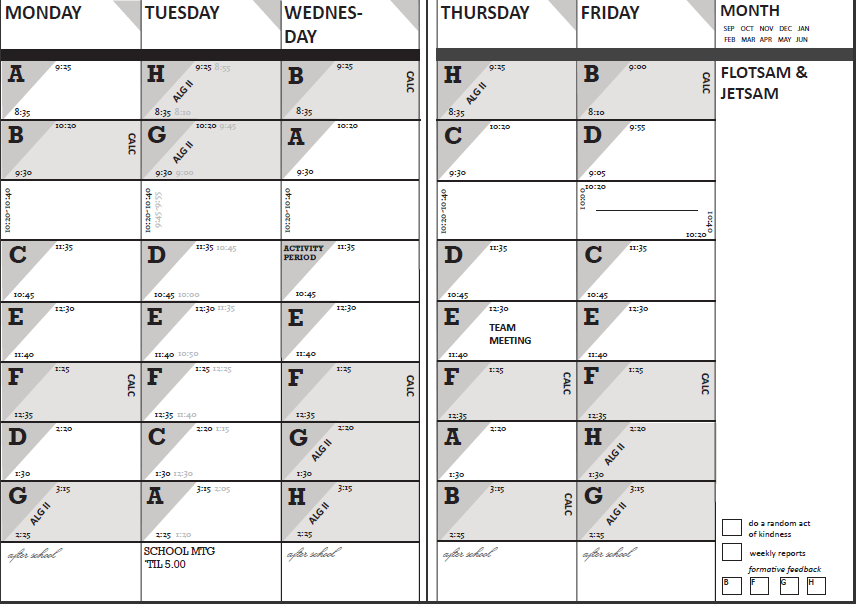
So I've got about 150 finals to score preliminarily, which is why it made SO MUCH SENSE for me to use much of this precious Sunday to make my own version of Sam's amazing personalized planner.

Here is Sam's planner:

And here is my version:


I think this even counts as a #Made4Math entry, although it should probably be listed as a #MadeInsteadOfMath submission. :)

Sunday, December 8, 2013

A dented patchwork circle: new school, new impressions

This was my first week in my new school, which means I've been going through a few simultaneous transitions: (1) from middle schoolers to 11th and 12th graders, (2) from a 15-mile commute to a 1.5-mile commute, and (3) from a high-performing to a very diverse, high-need school.

I could not be more excited.

This first week was challenging because my partner-teacher and I were making a transition we could not inform them about fully until the end of the week. Also, he is beloved, which makes him a tough act to follow. But he is also my friend, so it was good, I think, for the kids to see that even math teachers have math teacher friends and that we are working hard to support them in a difficult transition. We did a restorative circle with Advisory so that everyone could be heard in the process of leave-taking, and we will do a round of circles with everybody tomorrow, Monday, to acknowledge the transition and to embody the process of support.

Our talking piece for circle practice is The Batman Ball — a small, inflated rubber ball with Batman on it that moved around the circle as each participant expressed his or her feelings about our shared situation.

What really struck me was their honesty and their authenticity. They honored the circle and each other. And they were willing to give me a chance. I know I will probably receive some of their displaced frustration and feelings of abandonment over the next few weeks, but they were making positive, honest effort that was moving to witness. For the guys in the class, it was especially hard. Most of them have at least one strong female authority figure in their lives, but for many of them, Mr. T was it — their one adult male role model: a young, whip-smart, kind, funny, warm, math-wizardy hipster with oversized glasses, a ready smile, and a heart the size of the ocean.

"Meetings end in departures," the Buddha said, but the fact that it's true doesn't make it any easier. They're still here, and now with me, but their hearts are going to be hurting for a little while. Plus we have finals coming up.

The other thing that made me happy to see was that they are incredibly capable math learners — more capable than they realize. Our department uses complex instruction pretty much exclusively, which was one of the reasons I really wanted to teach there. These gum-cracking wiseacres some of whom live in situations which are hard for most of us to imagine will sit their butts down in their table groups and do group work. I mean serious, collaborative mathematics.

The fact that they don't yet believe in themselves is a different problem. But that is a workable problem too.

My classroom is across the hall from the Special Ed department's special day class, and they are generous with their chilled filtered water and holiday cheer.

So tomorrow is another new beginning. I am trying to stay open and to notice and not to hesitate as I jump in. I am dressing warmly, drinking lots of water, and making effort to be present with an open heart. Looking forward to seeing what happens next.

Thursday, December 5, 2013

Thank you, Nelson Mandela

I first heard about Nelson Mandela and apartheid at Princeton, but it was not until I was a young lecturer at Stanford that he became real for me. 

A national political student movement had started during those years, aimed at educating students at elite private universities to demand that their universities' boards of trustees divest the universities of all their stock in companies that did any business in South Africa. 

When we young teachers and lecturers learned about apartheid and about the extent of Stanford's investments in companies that supported and did business with that brutal regime, it simply made sense to us to use our white privilege to speak up and speak out as part of the divestment movement. That was when all of my friends and our students simply held our classes outside the university president's office, in the quadrangle. 

Stanford was a pretty conservative university in those days, politically speaking (Condoleeza Rice was the provost!), and so it was only a matter of time before this caught the attention of the regional news media.

Several times a day, the university president had to pick his way through a sea of privileged white kids, sitting on the cobblestones, teaching and learning and protesting peacefully.  And these were not exactly the optics the administration was looking for.

This growing scene helped to create the pressure necessary to bring about Stanford's divestment from South Africa.

It would be almost another ten years before Nelson Mandela would be freed from prison, but it was inspiring to be a part of the divestment movement. At a time when a national motto seemed to be, "Greed is good," it gave me a belief in the power of ordinary good people speaking up peacefully.


Thursday, October 31, 2013

And *THIS* is why I love the MathTwitterBlogosphere, part 573 – Infinite Tangents interviews Lisa Henry, Part 1

There are some very good things about Halloween on a school day, but a mandatory classroom "party" in advisory last period of the day on a Thursday is not one of them.

When I had finished complaining to myself about the state of my classroom and cleaning up the last of what the 13-year-olds had left behind that really bothered me, I packed up my stuff and got into my car.

And I remembered that I had an Infinite Tangents podcast all cued up for myself — one I'd been saving for a moment when I needed it most. A moment like now.

So I got to spend the drive home with Ashli and Lisa Henry. Part 1. A glorious triumph of delayed gratification.

I feel lucky to have gotten to know Lisa first through Twitter and blogs and then in person at the first Twitter Math Camp in 2012. Lisa has a gift for teaching through community-building, and she has brought this gift to bear on Twitter Math Camp. I admire and appreciate her respectful and inclusive community-building, and it inspires me in my own classroom and in my life.

Now, like most teachers, I come from a family of storytellers, so it's probably no surprise that I love hearing other people tell the stories of events I participated in. I love the prismatic contrasts of perspective and memory – the way something that struck you as essential to an event gets bumped down or deflected sideways in another person's memory due to proximity or overtaking or whatever. So I love hearing Ashli and her guests telling stories of events I remember because that process invokes the same pleasure twice – the memory of the event itself and the joy in the retelling.

My mood lifted considerably as I gained distance from school and lost myself in the conversation and the memories they were weaving on my car stereo.

It was fun to hear about and remember the great Facebook "befriending" moment in 2011 or so—that moment over Christmas Break when a bunch of individuals who'd been nothing more than virtual colleagues on Twitter (but who were still basically strangers) decided to take the seemingly insane step of "friending" each other on Facebook.

It was a moment of enormous risk.

It's one thing to share teaching ideas or goof around on Twitter, but crossing that line between virtual and IRL felt profound. What if these people turned out to be crazy? unpleasant? dangerous? Or even worse — what if they turned out to have different political beliefs than I did?

The risk felt very real at the time, and sometimes it still does. I don't pretend to be something I am not. I am a liberal. I live in San Francisco. I am a practicing Buddhist and a Democrat. My representative in Congress is Nancy Pelosi. I believe in a lot of things I know that a lot of other people in other parts of the country do not.

But the one thing I know in my feet is that I am a teacher — and a learner.

And I knew that all of these other teachers all over the continent who had become my tentative friends and virtual colleagues on Twitter in exploring what it means to teach and learn math were every bit as committed to what that means as I am. So I guess I trusted it. I was willing to go with it, and to push myself beyond my comfort zone for the sake of connecting with a community of like-minded math teachers who want the same things for our kids and for our communities and for our countries — regardless of what we may believe at the grassroots personal level.

And with all of that as background, I have to admit — it was one of the best and most profound decisions I have ever made.

I was one of those crazy ten or fifteen people who was hellbent on attending Twitter Math Camp even if we had to hold it in a yurt outside a garbage dump. I knew that these were people I wanted to be connected to and spend time with and get to know, even if we seem like we'd be completely incompatible based on what you can see from examining our surfaces.

There was a (now-hilarious) period of several months when it seemed as though what my new friends most wanted us to do was to go on a cruise together and do Exeter or PCMI problem sets together. I remember that Julie looked into costs and group rates and I thought to myself, what in the name of everything sacred have I gotten myself into? I hate situations like cruises. I get seasick. I could imagine nothing worse than being trapped on the open ocean for days with people I don't know.

But there was something about the energy of the group that I innately trusted.

I kept my cruise-hating thoughts to myself, but I hung in there because I knew I did not want to miss out on what appeared to be happening. These were people I wanted to spend time with, and I supposed that if that meant I would HAVE to spend time on a cruise ship, I could probably get a prescription for some kind of anti-anxiety medication to have on hand in case I completely freaked out.

And I just hung in there.

Eventually, the cruise ship idea fell apart, thank God, and the math camp idea came together. And nothing has been the same in my life ever since. And it's been good. Very good.

By the time I went through the toll plaza at the city end of the Golden Gate Bridge, I was not only not crabby any more, I was actually happy.

I felt connected to something much larger than my own daily grumbles, and that was enough to wash all the grouchiness away.

By the time I had parked the car, walked the dog, and poured myself a beer, I realized I needed to blog about my drive as a way of remembering what was good and sane and life-affirming about this experience I am having of being part of a worldwide community of math teachers who see teaching as something much larger than what is happening just in our classrooms.

So this is my "One Good Thing" for the day. Thank you, MathTwitterBlogoSphere, for being there on the other end of the Twitter line whenever I need to feel connected.

Gasshō.

Wednesday, October 30, 2013

Mathalicious New-Tritional Info Lesson – CC Math 6, units, calorie burn rates, celebrities, and oh, yeah, BURGERS!

DAY 1 - Tuesday

We started Mathalicious' New-Tritional Info today in my Math 6 class. We are not a fast-paced group, so it is going to take us more time to get through the lesson. We spent Tuesday working on Act 1 of the basic lesson.

I would echo everything my friend the inimitable Julie Reulbach had to say about the Mathalicious pacing and student worksheets. As Julie says,
I have to give a shout out to Mathalicious lessons right now.  I’m impressed with the way the student sheets are structured.  The directions are very clear and accessible to students so they can get right to work without tons of questions or further explanation from me.  This allows me to walk around and observe so I can see where my students are and help the ones that are struggling.  The questions also progress in the lesson so that students use their previous work to make discoveries.  This is really tough to do when creating lessons.  Kudos guys!
A couple of students were quicker than others to catch on, so I gave them the off-the-cuff extension idea to research online the calorie "burn rate" values of other activities such as singing (since Selena Gomez was the first example person given in the table). Once we found the burn rate, I divided those by the given poundage of the person performing the activity, and voilà – we had the burn rate per pound per minute. It was rather low – like around 0.0114 calories per pound for 1 minute worth of singing.

Then I had those students go back through the table and figure out how many calories Justin would burn by singing, how many Abby would burn, and how many LeBron would burn. The kids enjoyed imagining LeBron singing and figuring out his calorie-burning for that combination.

You could add on any variety of activities for this extension, such as kazoo-playing, knitting, thinking, etc. It gave the faster students a job to do (finding and converting) and it gave the slower students an incentive to hurry their little butts up on what they needed to focus on (can you spell "sixth graders"???).

A strange thing happened in my second class (5th period). An argument broke out between two factions: one who believed with all their hearts that Larry Bird had come along and stolen LeBron's lunch, and another faction that believed with equal vehemence that it was, in fact, former President Bill Clinton who had skipped out with the lunch at the end of the commercial.

Everyone in this class (except me) was born in 2002, so they probably aren't the most reliable eyewitnesses in the world. But I thought it was interesting how many of them insisted that the lunch-filcher was Bill Clinton.

Anyway, food for thought.

DAY 2 – Block Day

We worked on side 2 of the New-Tritional Info worksheet today. Students were more confident today with the various units, burn rates, unit rate conversions, and corresponding activities. For my classes, this was a good pace.

Tomorrow is our other Block Day, so I'll do the same lesson with my other 6th grade class.

Can't wait to integrate Julie's Desmos ideas and extensions next week!


Sunday, October 27, 2013

Noticing and Wondering as a practice with my 6th graders

When I'm using MARS tasks with my 6th graders, I have found no structure to be more effective in aligning their attentions and energies to the task than the Math Forum's Noticing and Wondering structure.

We kind of go into a "noticing and wondering" mode, in which we are choosing to limit our our monkey mind attention to just plain noticing and we let go of any other kind of attention that comes up during that cycle.

Noticing, in particular, is a quiet and nurturing structure for kids to simply be present with what they notice. We are not privileging noticings or knocking down noticings, we are simply welcoming them as valued and arriving guests.

6th graders love having a structure, so they loved the structure of noticing. Then once we'd heard from everybody,we did a round of noticing. It's powerful when space is allowed to sit with this first round of work.

Look at all these amazing insights they had:


We took a little time to admire this collection. It's a great list!

They even did great a great job of thinking about the value of doing noticing and wondering at the start. The first item from the link is from @fnoschese, whose wisdom even my middle schoolers can grasp.


Doing this task together and then talking about it made students reflect in deep ways about what kinds of growth processes were going on for them.
I just wanted to share this one implementation for anybody who is interested in ways you can use this.